
Beamline 7.2W
Macromolecular Crystallography

Welcome to BL7.2W
-
Macromolecular Crystallography (MX): High‑resolution protein and biomolecular structure analysis
-
X-ray Absorption Spectroscopy (XAS): Oxidation states and local atomic environment studies
-
Grazing Incidence X-ray Absorption Spectroscopy (GIXAS): Surface and thin‑film characterization
-
Micro-X-ray Absorption Spectroscopy (Micro-XAS): Localized atomic structure at the microscale
-
Wide-Angle X-ray Scattering (WAXS): Crystalline and polymer structure investigation
-
Grazing Incidence Wide-Angle X-ray Scattering (GIWAXS): Thin‑film and surface crystallography
-
X-ray Fluorescence Spectroscopy (XRF): Elemental composition analysis
-
Micro-X-ray Fluorescence Spectroscopy (Micro-XRF): High‑resolution elemental mapping
-
Total Reflection X-ray Fluorescence (TXRF): Ultra‑trace element detection

Superconducting Wavelength Shifter (SWLS)
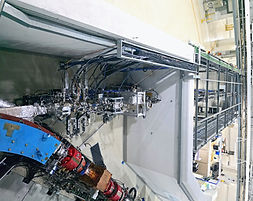
Front-End of BL7.2W

Optical Hutch at BL7.2W
Beamline Capabilities
-
X-ray Beam Properties: Monochromatic and tunable for precise experimental control
-
Energy Range: 4.0 –22.7 keV (3.10–0.55 Å)
-
Photon Flux: 5 × 10¹⁰ to 1.4 × 10¹¹ phs/s/100 mA
-
Beam Size: 20 µm @12 keV for micro-beam techniques
-
Beam Footprint: Adjustable up to 10.32 mm while maintaining suitable flux for TXRF measurements
-
Sample Environment: Helium chamber for light element analysis
-
Motorized Stage: Six-axis control for grazing incidence techniques
-
Gas Mixing System: Automated and user-friendly for XAS experiments
The beamline utilizes hard X-rays generated by the 6.5-Tesla Superconducting Wavelength Shifter (SWLS) and supports a wide range of advanced experimental techniques, including:
Applications Across Scientific Fields
BL7.2W has been utilized in diverse research areas:
-
Environmental science
-
Agricultural and plant science
-
Food science
-
Geochemistry and gemology
-
Cultural heritage and archaeology
-
Biochemistry and medical research
-
Catalysis and materials science